
Giraffes Can’t Dance was one of those books my kids loved when they were younger. We read it over and over, and I always loved that music was such an important part of the story.
As a music teacher, I also couldn’t help noticing what a perfect starting point it was for a music lesson. Waltzes, tangos, cha-chas, Scottish reels, rock, and boogie-woogie are all woven right into the story—giving kids a natural opportunity to actually hear and experience the different musical styles they’re reading about.
That’s what inspired me to create this Giraffes Can’t Dance music lesson for grades K–3. I wanted students to do more than simply learn the names of the musical styles in the story. I wanted them to hear the music, see and hear the instruments, discover where the styles came from, and—of course—get up and move!
The result is an interactive lesson that takes students on a musical journey through each of the six styles featured in the book.
Musical Styles in Giraffes Can’t Dance
Throughout Giraffes Can’t Dance, the animals dance to six very different types of music:
- Waltz
- Tango
- Cha-Cha
- Scottish Reel
- Rock
- Boogie-Woogie
For each style, students explore the music in several different ways—through geography, listening, instruments, and movement.
This gives young students concrete experiences they can use to begin hearing and describing the differences between musical styles.
1. Find the Music on the Map
The lesson begins by connecting each musical style with a place on the world map.
It’s a simple way to help young students make an important connection: music comes from different people, places, and cultures.
Students don’t need an extensive geography lesson. Simply seeing where the music originated gives each style some context and adds a natural cross-curricular element to the lesson.
As students travel from one musical style to another, they’re also taking a little musical trip around the world.
2. Listen for the Differences
Of course, the most important part of learning about a musical style is actually hearing it.
Students listen to musical examples and begin comparing what they hear.
For younger students, listening can focus on simple questions such as:
Is the music fast or slow?
What instruments do you hear?
Does the music sound smooth or bouncy?
What does this music make you want to do?
Even kindergarten and first-grade students can begin comparing musical styles when they’re listening for characteristics they can actually hear.
Older students can go a little further by describing differences in tempo, instruments, beat, mood, and other musical characteristics.
3. Explore the Instruments
Students also get to see and hear instruments associated with the different musical styles.
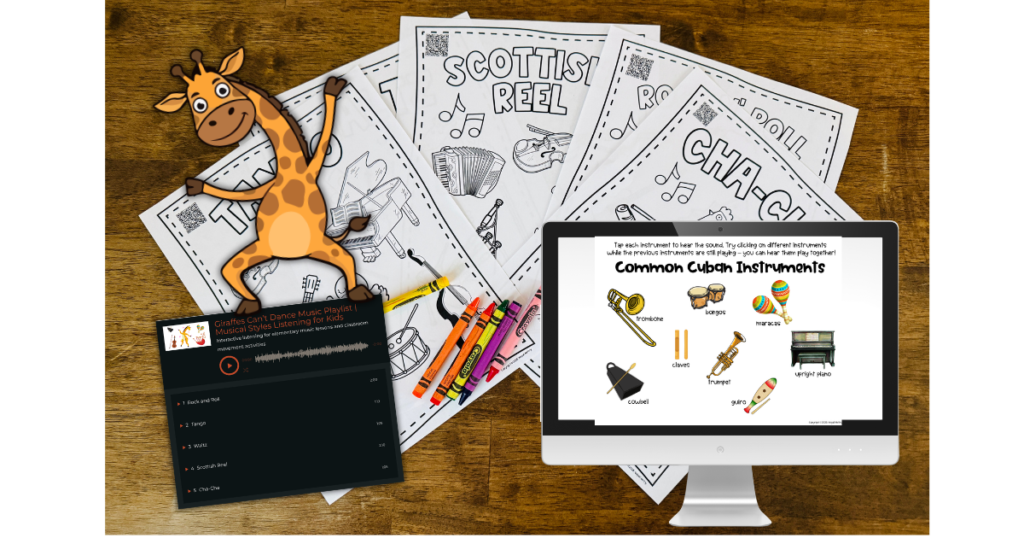
I included interactive Tap & Hear activities that allow students to select an instrument and hear what it sounds like.
Then, when students listen to the complete musical example, they have something specific to listen for.
This gives them another way to distinguish between musical styles while naturally incorporating instrument identification and timbre into the lesson.
4. Add Music and Movement
Of course, a book about dancing practically begs for movement!
The lesson includes simple dance and movement examples connected to the different musical styles. Students can see how people move to the music and then get up and experience it themselves.
A waltz feels very different from rock or boogie-woogie, even if a young student doesn’t yet have the musical vocabulary to explain why.
The goal isn’t to teach a complicated dance routine. Instead, movement becomes another way for students to listen and respond to the character of the music.
For young children especially, experiencing those differences physically can make musical concepts much more meaningful.
5. Extend the Lesson With Coloring and Listening
I also included printable Musical Style Coloring & Listening Pages for a quieter way to continue exploring the music.
Students can listen to music from one of the styles while coloring the corresponding page.
These work well for:
- Music centers
- Follow-up lessons
- Early finishers
- Sub plans
- Homeschool music
- Calm Listening Activity (especially helpful after all of that dancing!)
It’s an easy way to give students another opportunity to hear and become familiar with the musical styles after the interactive portion of the lesson.
What Can Students Learn From Giraffes Can’t Dance?
One of the things I love about using Giraffes Can’t Dance in music class is how many different musical concepts can grow naturally from one familiar story.
Through listening, movement, instruments, and geography, students can practice:
- Identifying and comparing contrasting musical styles
- Recognizing instruments by sight and sound
- Connecting music with different places and cultures
- Responding to music through movement
- Developing active listening skills
- Describing what they hear in music
It also creates an easy cross-curricular connection between music and children’s literature, making it useful for elementary music teachers, classroom teachers, and homeschool families.
Ready to Try the Giraffes Can’t Dance Music Lesson?
If you’d like to use these activities with your own students, I’ve put everything together in my Giraffes Can’t Dance Music Lesson: Musical Styles & Movement for grades K–3. Check it out below!
The ready-to-use resource includes an interactive PowerPoint lesson, musical listening examples, world map connections, instrument exploration with Tap & Hear activities, movement and dance examples, and printable Musical Style Coloring & Listening Pages.
You can use the lesson alongside Giraffes Can’t Dance as a book extension, or use it on its own as a fun introduction to contrasting musical styles.
Standards Connection
This Giraffes Can’t Dance music lesson supports the National Core Arts Standards areas of Responding, Connecting, and Performing as students listen to and compare music, connect musical styles with different places and cultures, and respond to music through movement.
For young students, the most important part is the experience: hear the music, see the instruments, find its place on the map, and move.
It’s a simple way to turn a favorite children’s book into an engaging elementary music experience that brings together literature, listening, movement, instruments, and geography.