
By Abigail Mettry | Music Educator, Composer & Elementary Music Resource Creator
There are some music activities that students never seem to get tired of—and Bingo is one of them.
As a music teacher, I love activities that feel like a game to students but still give them meaningful practice with the skills we’re working on. What better way to do that than with this set of Rhythm Bingo games!
Instead of completing another worksheet or reading rhythm patterns one at a time, students listen, read, and identify rhythms while trying to be the first to get Bingo.
And because rhythm skills change so much from kindergarten through fifth grade, I created different levels so teachers can choose a game that matches exactly what their students are learning.
Why Use Rhythm Bingo in Music Class?
Rhythm Bingo takes a familiar game and turns it into rhythm reading and listening practice.
Depending on how you play, students can practice listening to a rhythm and finding the matching notation, reading rhythm patterns independently, recognizing familiar notes and rests, and distinguishing between similar rhythm patterns.
The repetition is important—but it doesn’t necessarily feel repetitive to students.
They’re focused on finding the rhythm on their card and getting Bingo. Meanwhile, they’re seeing and identifying rhythm pattern after rhythm pattern.
Rhythm Bingo for Different Grade Levels
One challenge with elementary music is that a rhythm game that’s perfect for kindergarten probably isn’t going to provide much practice for a fifth grader.
That’s why I designed my Rhythm Bingo series as a progressive set of levels for grades K–5.
Beginning students can work with simple rhythm concepts, while older students can play with increasingly challenging notes, rests, and rhythm patterns.
This makes it easy to use the same familiar game format across multiple grade levels without teaching students an entirely new activity every time.
Once students know how Rhythm Bingo works, you can simply change the musical content as their skills progress.
An Easy Rhythm Game for Review
Rhythm Bingo works especially well when students already know the rhythmic concept and need more opportunities to practice it.
I like to think of games like this as the practice part of music learning.
Students first learn a rhythmic concept. Then they need to encounter it again and again until recognizing and performing it becomes increasingly automatic.
A game gives them that repetition without simply giving them more of the same exercise.
It can work particularly well for:
- Rhythm review
- Music centers
- Whole-class games
- Beginning or ending a lesson
- Assessment review
- Sub plans
- Homeschool music
- Extra practice before introducing a new rhythm concept
Rhythm Bingo as an Informal Assessment
Games can also tell you quite a bit about what students understand.
As students play, you can quickly notice who recognizes rhythms immediately and who is still looking carefully through every option.
If you’re performing the rhythms by ear, you can also see whether students are successfully connecting rhythmic sound with rhythmic notation.
It doesn’t have to feel like an assessment to students, but it can give you useful information about whether they’re ready to move on or need more practice.
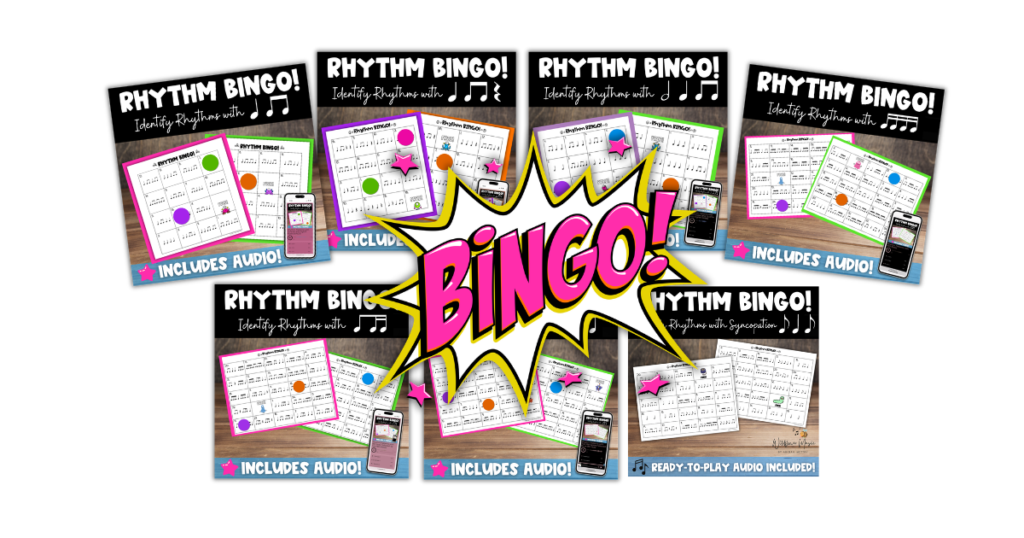
Ready-to-Use Rhythm Bingo Games for K–5
I created my Rhythm Bingo series so elementary music teachers can use the same game format as students progress through increasingly challenging rhythm concepts.
Each level focuses on age-appropriate rhythm skills, making it easy to choose the version that fits what your students are currently learning.
You can use an individual level with a specific grade or rhythmic concept, or use the complete K–5 Rhythm Bingo Bundle to build rhythm practice across your elementary music program.
If you’re looking for an easy way to add more rhythm reading and listening practice without adding another worksheet, Rhythm Bingo is a simple activity to keep in your music-teaching toolbox.
Building Stronger Rhythm Readers
Learning rhythm takes repetition.
Students need opportunities to see rhythms, hear rhythms, perform rhythms, and connect the sound with the notation.
Rhythm Bingo doesn’t replace direct rhythm instruction. Instead, it gives students a fun way to practice what they’ve already learned.
And sometimes turning that practice into a game is all it takes to get students excited about doing it again.

About the Author
Abigail Mettry is a music educator, composer, arranger, and pianist who creates engaging music resources for elementary classrooms and homeschool families. Her work combines music education with professional composing and arranging experience to help children build strong musical foundations. Learn more about Abigail.