
By Abigail Mettry | Music Educator, Composer & Elementary Music Resource Creator
Teaching the instruments of the orchestra can involve a lot of names to remember: violins and violas, oboes and bassoons, trumpets and trombones—not to mention instrument families, listening examples, conductors, and orchestra vocabulary.
So why not turn the whole thing into a game show?
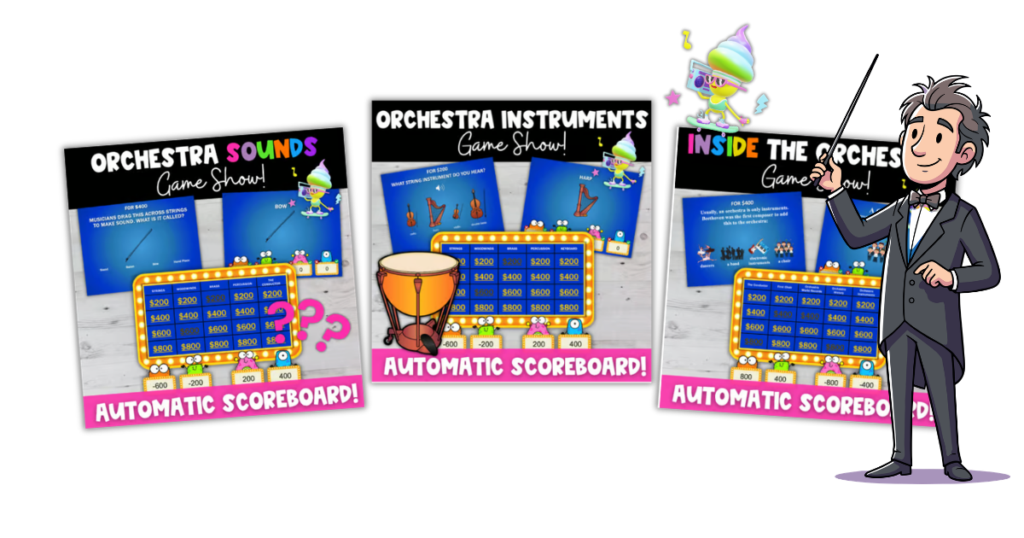
I created a series of Jeopardy-style orchestra games for elementary music that let students learn and review the orchestra by choosing categories, answering increasingly challenging questions, listening to real instrument sounds, and competing for points.
And I wanted them to feel like actual game shows—not just PowerPoint quizzes with points attached.
Here are three different ways I use the game-show format to teach orchestra instruments, listening, and even some of the coolest weird stories from orchestra history.
1. Turn Instrument Identification Into a Listening Challenge
One of the most important things students can learn about orchestra instruments isn’t what they look like.
It’s what they sound like.
Can they hear the difference between a flute and a clarinet?
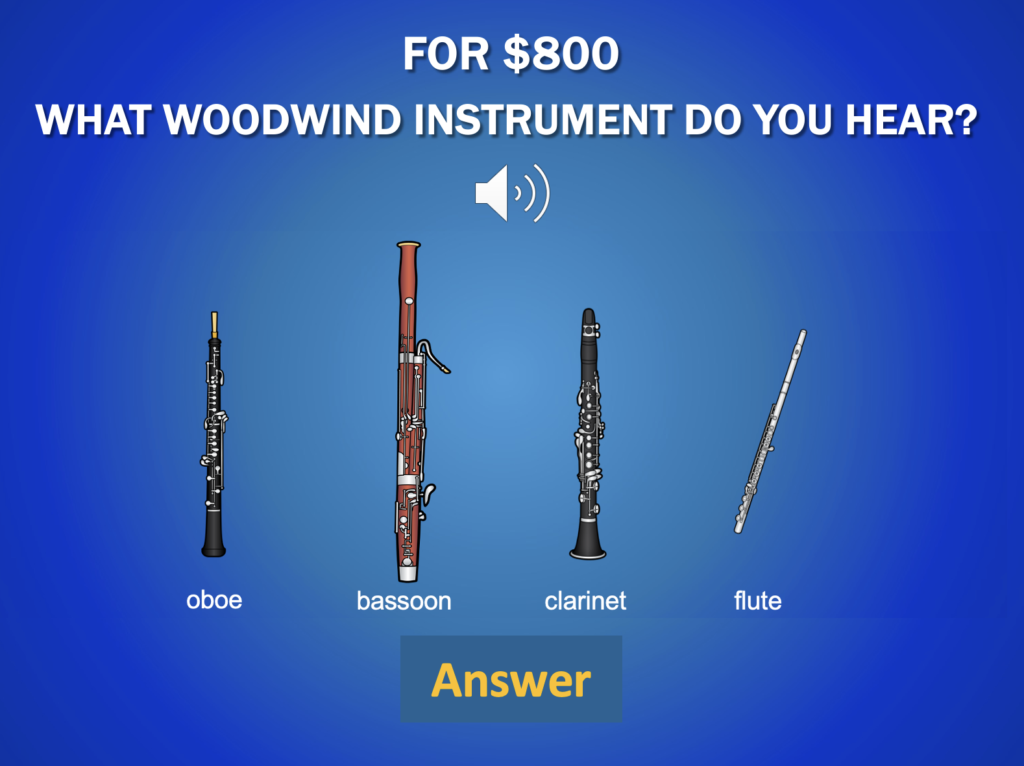
That’s where listening games become especially fun! Instead of showing students an instrument and asking them to name it, turn the question around: What instrument do you hear?
Suddenly they’re listening for clues:
Is it high or low? Bright or mellow? Does it sound like a string? Could that be brass?
My Jeopardy-style Orchestra Instruments Game Show turns this into a full-class competition. Students choose from Strings, Woodwinds, Brass, Percussion, and Keyboard categories and listen to actual instrument sounds to identify what they hear.
And because the questions get progressively more valuable, suddenly identifying a bassoon isn’t just identifying a bassoon.
It’s a question worth 800 points!! Much more exciting.
2. Go Beyond “What Instrument Is This?”
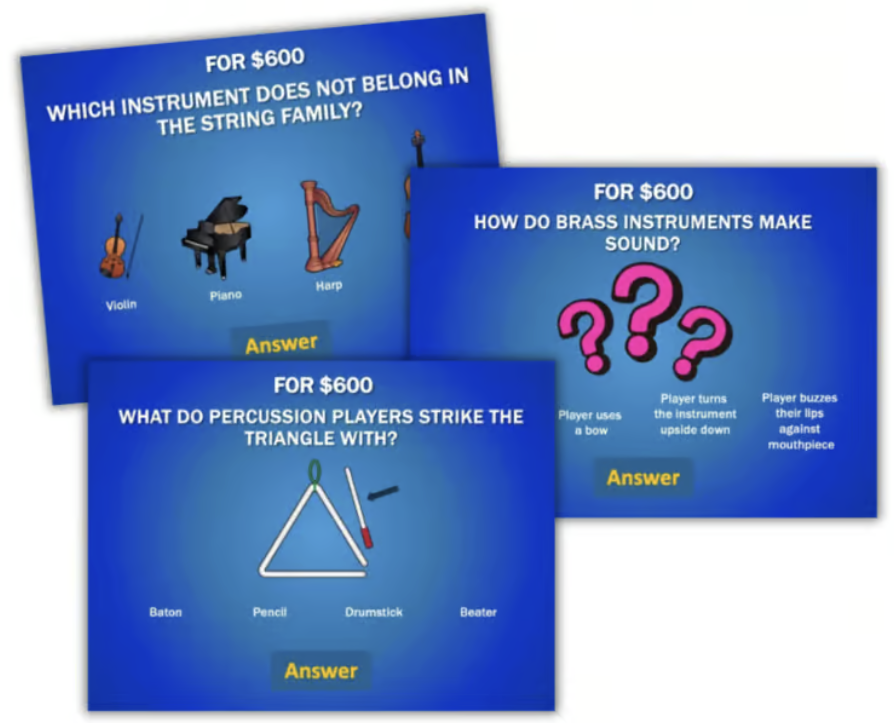
My Orchestra Sounds Game Show was designed for this next step.
Rather than simply identifying instruments, students explore the sounds and characteristics of strings, woodwinds, brass, percussion, and the conductor.
I especially like this kind of game because it moves students from:
“That’s a trombone.”
to:
“I understand something about how a trombone works and why it sounds the way it does.”
That’s a much richer understanding of the orchestra.
3. Let Them Discover the Weird Stuff
This may be my favorite part. The orchestra has some great trivia!
Conductors. First-chair musicians. Orchestra history. World records. Strange stories.
That’s why I created my Orchestra Trivia Game Show around categories including The Conductor, First Chair, Orchestra World Records, Orchestra History, and Orchestra Instruments.
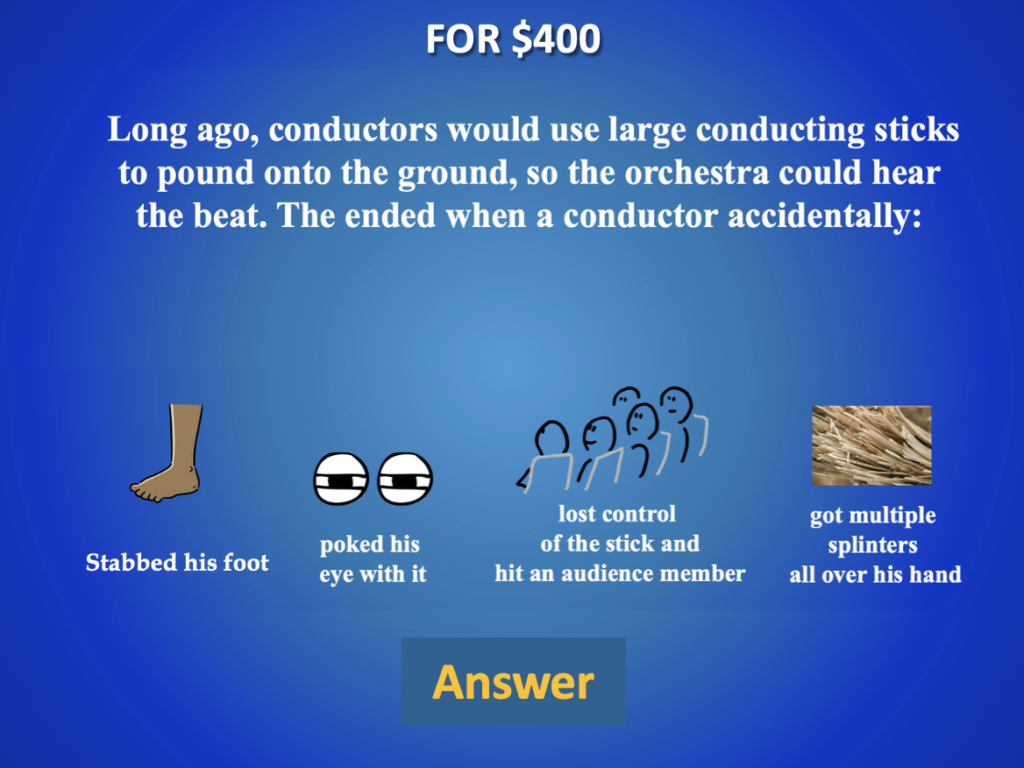
One question, for example, introduces students to the rather unfortunate story of conductor Jean-Baptiste Lully, who conducted by pounding a large stick on the floor—and accidentally struck his own foot.
It’s bizarre.
And I can almost guarantee students are going to remember it.
Those unexpected stories give students a glimpse of the orchestra as something with an actual history and culture—not just four instrument families printed on a worksheet.
4. Make Review Feel Like a Real Game Show
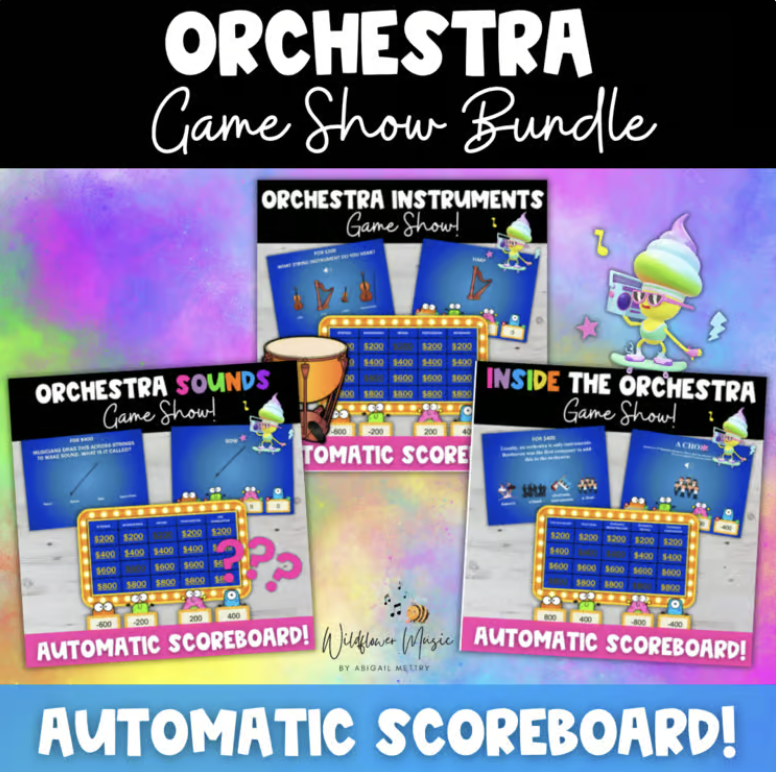
This is why I recently put my three orchestra game shows together into an Orchestra Game Show Bundle.
I wanted them to feel like an educational competition, not PowerPoint quizzes pretending to be games.
Students divide into teams.
They choose a category.
They choose a dollar amount.
The question appears.
They debate the answer.
Then comes the moment of truth.
And the scoreboard is built directly into the game, so the teacher doesn’t have to keep stopping to calculate points somewhere else.
There are even surprises hidden in the games—including a surprise Marshmallow Man hidden on one of the slide – who can suddenly double a team’s score…or double-subtract it.
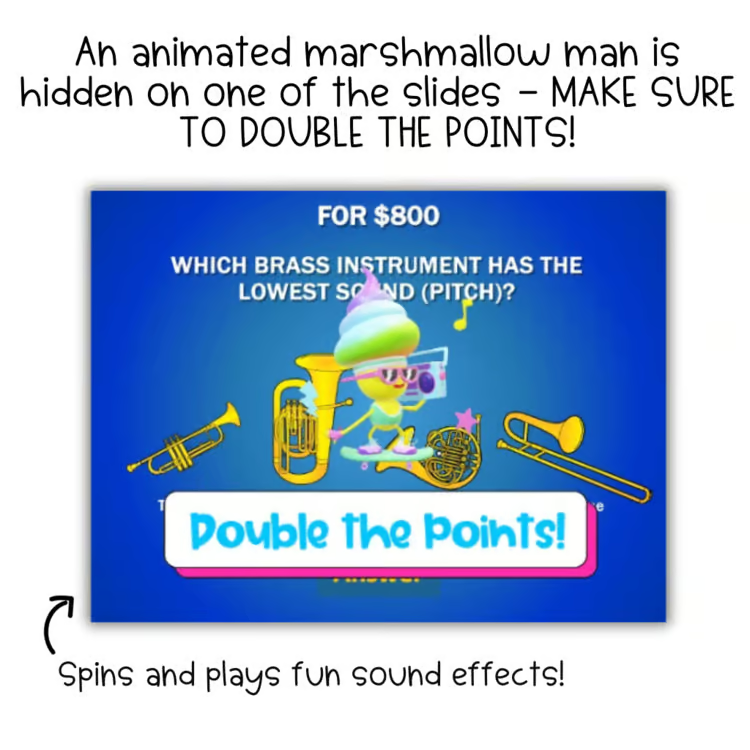
Those little elements don’t change the learning objective. But they do change how fun learning can be!
Behind the Scenes: The Game Show Theme 🎵
One of my favorite little details in these games is the theme music that plays every time students return to the main scoreboard. I actually composed it myself!
When I started writing it, I was trying to create something with the quirky, slightly offbeat feel of the Curb Your Enthusiasm theme—the kind of music that immediately makes you feel like something funny is about to happen. But, as often happens when I’m composing, it took on a life of its own and turned into something completely different.
I was also having a lot of fun experimenting with the orchestral sounds in ProjectSAM’s Orchestral Essentials while working in Logic Pro. The different instrumental colors helped inspire the direction of the piece, and somewhere along the way I realized: this sounds like game show music!
So that little theme became the musical “home base” for my game shows. Every time students finish a question and return to the scoreboard, they hear it again. It’s a small detail, but I think it adds to the feeling that they’re participating in an actual game show rather than simply answering questions on a screen. Take a listen below!
The Orchestra Is Made for Listening
Ultimately, that’s what I want students to take away from an orchestra unit.
I don’t just want them to memorize:
violin = strings
clarinet = woodwinds
trumpet = brass
I want them to start recognizing those instruments when they hear music.
I want a student to hear a solo somewhere months later and think:
Wait…is that an oboe?
Because once they start listening for individual instruments, an orchestra stops sounding like one giant mass of sound.
They begin hearing the musicians inside it.
And that’s when learning the orchestra gets really interesting for kids.
Ready to Play?
Bring all three games into your orchestra unit.

About the Author
Abigail Mettry is a music educator, composer, arranger, and pianist who creates engaging music resources for elementary classrooms and homeschool families. Her work combines music education with professional composing and arranging experience to help children build strong musical foundations. Learn more about Abigail.