
“Twinkle, Twinkle, Little Star.” “Mary Had a Little Lamb.” “Hickory Dickory Dock.”
They may be simple, but nursery rhymes are packed with learning.
When children sing and recite nursery rhymes, they are experiencing rhythm, rhyme, repetition, vocabulary, storytelling, musical patterns, and the sounds of language—often all at the same time.
That makes nursery rhymes a unique bridge between music, poetry, language, movement, and early literacy.
And probably, this is one reason these little songs and rhymes have survived for generations!
Nursery Rhymes Are an Early Introduction to Poetry
Long before children encounter terms such as rhyme scheme, meter, or even poetry, they may already be experiencing these ideas through nursery rhymes.
Think about the natural rhythmic pattern of “Hickory Dickory Dock.” Children can hear and feel the pattern in the words without needing to know what poetic meter is.
Or consider the predictable rhyme in:
Twinkle, twinkle, little star,
How I wonder what you are.
Children are already experiencing some of the basic ingredients of poetry: rhythm, rhyme, repetition, imagery, pattern, and sound.
In fact, the connection between nursery rhymes and poetry is very direct. The Poetry Foundation includes traditional nursery rhymes in its poetry collections, making these familiar childhood verses a natural starting point for introducing children to poetic language.
So before children ever analyze a poem, they can hear and experience poetry through songs and rhymes.
Rhyming Helps Children Listen to the Sounds in Words
Nursery rhymes encourage children to pay attention not only to what words mean, but also to how words sound.
Star and are.
Wall and fall.
Moon and spoon.
As children begin to recognize rhyming words, syllables, and other sound patterns, they are developing phonological awareness—an awareness of the sound structure of spoken language.
This is important because phonological awareness is closely connected to later reading development. Reading Rockets identifies rhyming, syllables, alliteration, and awareness of individual speech sounds as parts of this important early literacy foundation.
The predictable nature of nursery rhymes makes them particularly fun for practicing this skill.
Try pausing before the final word:
Twinkle, twinkle, little star,
How I wonder what you…
Chances are, children who know the rhyme will immediately supply “are!”
They’re listening to language, remembering a pattern, making a prediction, and producing the missing word.
Repetition Is Part of the Magic
Adults sometimes tire of hearing the same children’s songs over and over.
For young children, that repetition can be incredibly useful.
BBC educational materials on songs and rhymes emphasize their simple, repetitive, rhythmic and patterned language. They also note that repetition, singing, movement, and related activities can help children memorize songs and rhymes, supporting language, listening, and auditory memory.
Every repetition gives a child another chance to hear the words, anticipate what comes next, join in, and eventually sing or recite the rhyme independently.
The repetition isn’t a flaw in a nursery rhyme.
It’s part of what makes it work.
Nursery Rhymes Can Build Vocabulary
Nursery rhymes are also full of interesting words.
How often does a young child hear words such as nimble, fetch, pail, merrily, or tuffet in everyday conversation?
Probably not very often.
Yet traditional songs and rhymes give children repeated exposure to unusual vocabulary in a memorable context.
Rather than introducing a word in isolation, you can stop during a familiar rhyme and ask:
“What do you think that word means?”
You can act it out, draw it, demonstrate it, or talk about another word that means something similar.
BBC’s early-years educational guidance also recommends carrying new vocabulary from songs, rhymes, and stories into children’s play and other activities so that they have additional opportunities to use and understand it.
Music Adds Another Layer of Learning
When a nursery rhyme is sung instead of simply spoken, another whole layer of learning appears.
Children can experience:
- steady beat
- rhythm
- melodic direction
- musical phrases
- tempo
- dynamics
- vocal expression
- listening and memory
This makes nursery rhymes especially valuable in the elementary music classroom.
For example, have students sing a familiar nursery rhyme while patting the steady beat on their knees.
Then speak the rhyme and clap the rhythm of the words.
Suddenly, a song children already know has become a way to explore one of the fundamental concepts in early music learning:
The beat stays steady. The rhythm follows the words.
Because the words and melody are already familiar, students can devote more of their attention to the new musical concept.
Add Movement for Even More Learning
.Nursery rhymes don’t have to be sit-down singing activities.
Action songs and rhymes invite children to connect what they hear with what their bodies do. Many nursery rhymes are also perfect for fingerplays, which pair words and music with small, purposeful hand and finger movements.
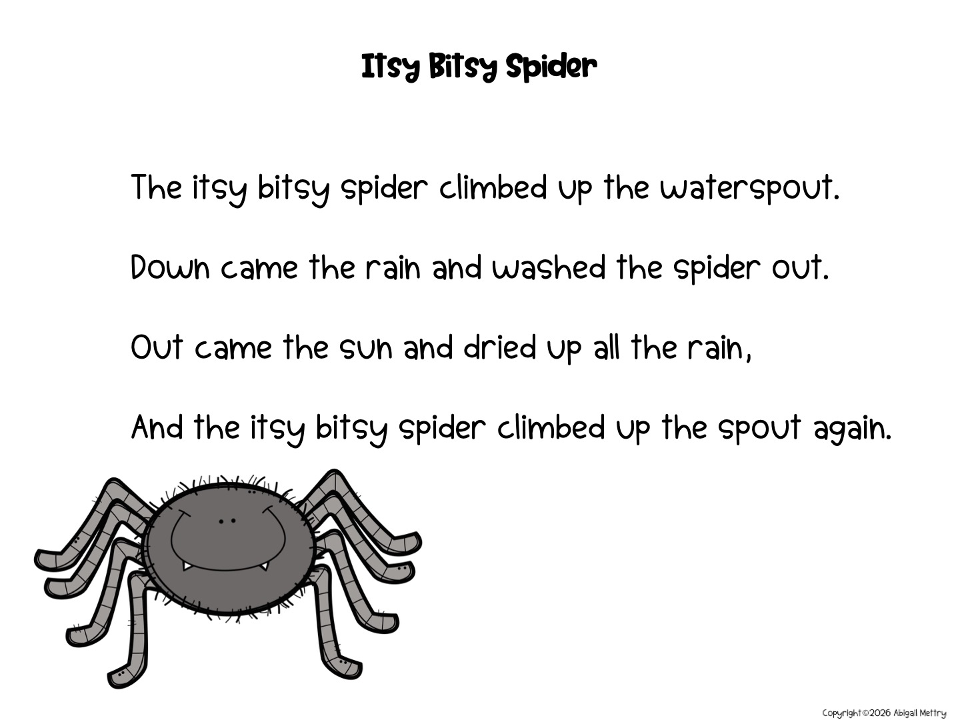
Think of “The Itsy Bitsy Spider.” As children sing, their fingers become the spider climbing the waterspout, their hands show the falling rain, and their arms create the sunshine. The motions help bring the words and story to life while giving children another way to participate in the song.
BBC early-years materials specifically suggest adding actions to songs and rhymes and using movement such as clapping, swaying, skipping, dancing, and marching.
In a music classroom, try having students:
- march to the steady beat
- create actions for important words
- add fingerplays to familiar rhymes
- clap the rhythm
- play the beat on rhythm instruments
- change movements when they hear a particular word
- freeze when the music stops
- create their own movements for a verse
Movement and fingerplays aren’t simply entertaining extras. They give children another way to experience, remember, and respond to the words and music.
Nursery Rhymes Help Children Recognize Patterns
Young children thrive on repetition and predictability, and nursery rhymes are full of both.
Children begin anticipating what comes next. They remember sequences. They recognize repeated phrases. They hear rhyming sounds.
And they notice when you get something wrong.
Try singing:
“Twinkle, twinkle, little… CAR!”
You’ll probably hear some immediate objections.
A child has internalized the pattern well enough to recognize that you broke it.
You can turn this into a classroom game by deliberately substituting silly words, leaving words out, or pausing and asking children to finish the phrase.
Nursery Rhymes Naturally Connect Music and Literacy
For music teachers, one of the best things about nursery rhymes is that you don’t necessarily have to stop teaching music to make a literacy connection.
The connection is already there.
After singing a rhyme, ask:
Which words rhyme?
Do you hear any repeated words or sounds?
Can you find the steady beat?
Can you clap the rhythm of the words?
Can you predict the next word?
Students are simultaneously thinking about language and music.
That’s a meaningful cross-curricular connection—and it doesn’t require turning music class into reading class.
Don’t Forget the Storytelling
Many nursery rhymes are also miniature stories.
Humpty Dumpty sits on a wall—and falls.
Jack and Jill go up a hill—and something goes very wrong.
A spider frightens Miss Muffet away from her snack.
These tiny narratives introduce characters, actions, sequences, problems, and sometimes very memorable endings.
BBC educational guidance encourages children to hear stories repeatedly, participate more as they become familiar with them, dramatize them, and eventually retell favorites themselves. The same approach works beautifully with narrative nursery rhymes.
Try asking students to put the events of a rhyme in order, act it out, draw what happened, or invent a different ending.
Now the rhyme has become a springboard for sequencing, comprehension, imagination, and storytelling.
Some Nursery Rhymes Even Sneak in Math
Music and literacy aren’t the only subjects hiding inside nursery rhymes.
Think about:
One, Two, Buckle My Shoe
Five Little Ducks
Five Little Speckled Frogs
Counting songs expose children to number words, numerical order, counting forward or backward, and simple ideas about quantities.
Again, children don’t necessarily experience this as an academic exercise.
They’re simply singing.
That’s part of what makes songs and rhymes so powerful for young learners: several kinds of learning can happen within the same playful activity.
Fun Fact: Who Was Mother Goose?
Here’s a fun fact to share with students:
Mother Goose wasn’t necessarily a real grandmother who sat around inventing nursery rhymes!
“Mother Goose” became a literary figure associated with traditional children’s stories and rhymes. The name has a history stretching back hundreds of years, including its association with Charles Perrault’s Tales of Mother Goose in the 17th century.
Over time, the Mother Goose name became closely connected with collections of traditional children’s rhymes.
So when children sing these songs today, they’re participating in a tradition that has been passed from one generation to another for hundreds of years.
The Library of Congress has an entire guide devoted to the fascinating history of Mother Goose and nursery rhymes.
10 Easy Ways to Use Nursery Rhymes in Music Class
Choose a familiar nursery rhyme and try one of these:
- Pat the steady beat while singing.
- Clap the rhythm of the words.
- Sing the song fast and slow.
- Experiment with loud and soft.
- Add classroom percussion instruments.
- Create motions for the words.
- Find the rhyming words.
- Pause before a word and have students finish the phrase.
- Speak the rhyme instead of singing it and compare the two.
- Let students invent a new verse using a new rhyming word.
Sometimes the better strategy is to take one song children know well and listen to it in ten different ways.
An Easy Way to Bring Nursery Rhymes Into Your Music Classroom
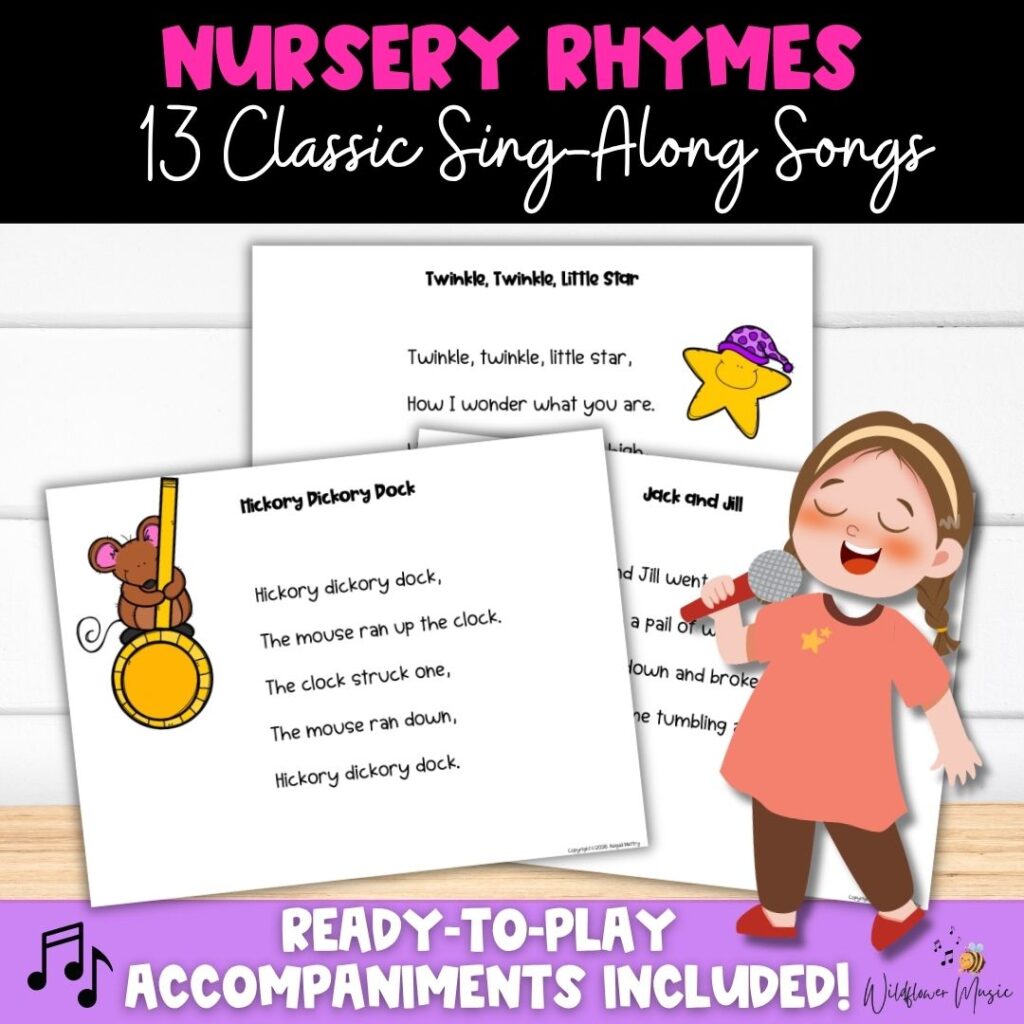
If you’d like to incorporate more nursery rhymes without having to accompany every song yourself, I created a Nursery Rhymes Sing-Along Songs resource with ready-to-use MP3 backing tracks and lyric slides.
You can use the songs for singing, movement, steady beat activities, rhythm practice, listening, transitions, or music-and-literacy connections.
They’re especially useful when you want to be up and interacting with your students instead of sitting at the piano.
Helpful Resources for Learning More
If you’d like to explore the research and ideas behind nursery rhymes, language, and early literacy, here are a few good places to start:
BBC Tiny Happy People — Offers practical information for parents and educators about children’s language development, including the value of songs and nursery rhymes.
Reading Rockets — An excellent resource for learning more about phonological awareness, rhyming, early literacy, and learning to read.
Poetry Foundation — Explore nursery rhymes alongside children’s poetry and other forms of verse.
Library of Congress — Its Finding Mother Goose guide explores the history of Mother Goose and traditional nursery rhymes.